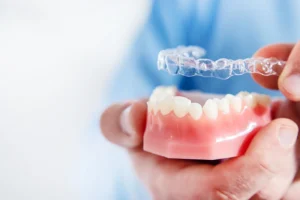
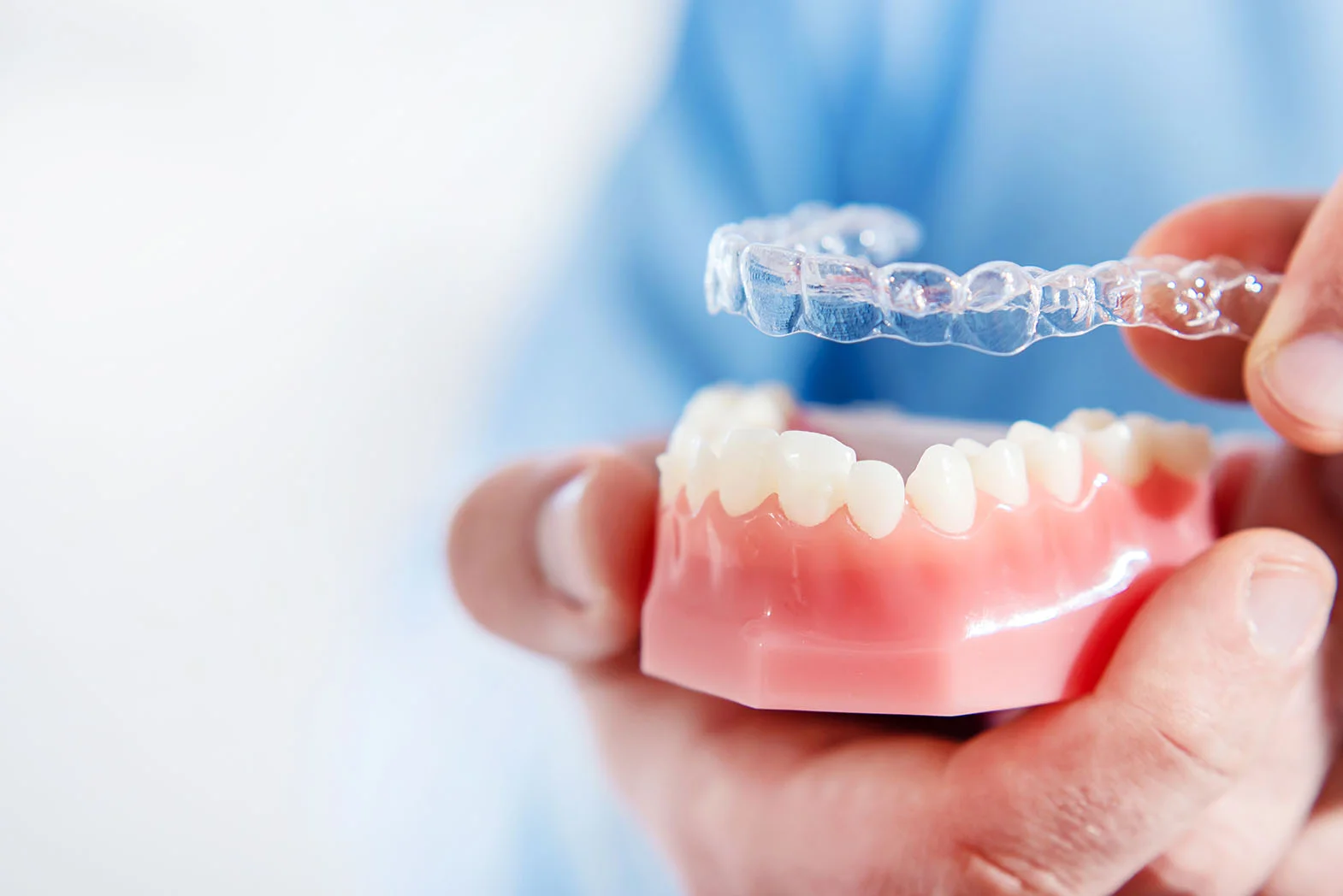
Many patients starting clear aligner treatment are surprised when, at their first appointment, small tooth-colored bumps are bonded to their teeth or the spaces between their teeth are slightly thinned. “Aren’t the aligners supposed to move my teeth on their own?” is a natural question. In this article, we briefly explain what attachments and IPR (interproximal reduction) — two important supporting steps in clear aligner treatment — are, why they’re done, and what they mean for you as a patient.
What Are Attachments?
Attachments are small, tooth-colored bumps, usually just a few millimeters in size, bonded to the surface of the teeth. They’re typically made of the same composite material used for tooth-colored fillings, and they help the aligners grip the teeth more effectively.
Why Are They Needed?
A smooth, flat tooth surface may not offer enough grip for a clear aligner to apply certain movements. Attachments allow the aligner to transfer force to the tooth in a more controlled way. They’re especially important for movements such as:
- Rotating a tooth around its own axis
- Moving a tooth up or down
- Moving the root portion of a tooth (correcting root angulation)
- Helping the aligner seat firmly on the tooth (retention)
How Are They Placed?
Placing attachments is generally painless and quick:
- The tooth surface is lightly prepared.
- A template prepared according to your digital treatment plan is placed over your teeth.
- Composite material is filled into the openings in the template and hardened with a special light.
- When the template is removed, the attachments remain in place on your teeth.
When treatment is finished, the attachments are easily removed by your orthodontist and the tooth surface is restored to its original smooth finish.
Are Attachments Noticeable?
Because they’re tooth-colored, they’re generally hard to notice unless someone is looking closely. And while you’re wearing your aligners, they’re covered anyway. If an attachment comes off during treatment, it’s important to let your orthodontist know, since the aligner’s effectiveness may be reduced — it’s usually easy to replace.
What Is IPR (Interproximal Reduction)?
IPR is the process of very slightly thinning a minimal layer of enamel (typically a fraction of a millimeter) from the sides of neighboring teeth where they touch. It’s sometimes called “tooth shaving,” but the goal isn’t to harm the tooth — it’s to create the small amount of space needed for the teeth to align.
Why Is It Done?
In a mouth with crowding, there may not be enough room for the teeth to line up properly. Ways of creating space include tooth extraction, palatal expansion, and IPR. In mild to moderate crowding, IPR can gain the small amount of space needed without the need for extractions.
Is It Safe?
IPR is performed by thinning the enamel in a controlled manner within defined limits. The procedure:
- Is planned taking enamel thickness into account; the safe limit for each tooth surface is not exceeded.
- Is performed with special fine abrasive strips or instruments.
- Is generally painless and doesn’t require anesthesia, since only the outer enamel layer is affected.
- Is followed by smoothing and polishing of the surfaces.
Your orthodontist decides whether IPR is needed and how much to perform based on your digital treatment plan.
Does IPR Lead to Sensitivity or a Higher Cavity Risk?
When performed correctly and in a controlled manner, no significant sensitivity or increased cavity risk is expected after IPR. Still, as with any orthodontic treatment, regular brushing, flossing, and periodic dental check-ups remain important throughout and after treatment.
Does Every Patient Need Attachments and IPR?
No. These steps are planned entirely on a case-by-case basis:
- Some patients may not need any attachments at all.
- In some patients, attachments are placed on just a few teeth.
- IPR is only performed in cases where space is needed, and only in the amount required.
These decisions are finalized by your orthodontist after your digital scan and 3D treatment simulation.
Conclusion
Attachments and IPR are natural parts of the treatment plan that improve the effectiveness and predictability of clear aligner treatment. The small bumps bonded to your teeth or the slight thinning between them contribute to achieving a straighter, healthier smile at the end of treatment. If you’re curious about any step, don’t hesitate to ask your orthodontist before starting treatment.
At Dr. Murat Kaptaç’s clinic, we explain the purpose and process of every planned step in clear aligner treatment to our patients in advance.
Contact us with any questions about clear aligner treatment.